Editorial by Isabella Goldmann
I want to talk about a phenomenon I find both beautiful and unexpected — the growing diffusion of Thanksgiving at the end of November across the world.
There’s something fascinating, almost poetic, about seeing an American tradition take root in places that never knew the Pilgrim Fathers. Thanksgiving, celebrated every fourth Thursday of November in the United States, is quietly becoming a custom in Italy, across Europe, and beyond. Not as a faithful copy, but as an occasion to pause and say thank you for what we have.
The original story is well known: in 1621, the first settlers who survived the Mayflower voyage celebrated the harvest with the Native Americans. In 1863, Abraham Lincoln made Thanksgiving a national holiday. Since then, 49 million Americans travel to be home for the occasion; streets fill with parades, and stuffed turkey takes center stage at family tables where every household guards its own secret recipe.
In Italy, Thanksgiving found its way through films and TV series, and then — more tangibly — through restaurants offering special menus. In Rome, Milan, and other cities, it’s now easy to find roast turkey with gravy, mashed potatoes, sweet potatoes, and pumpkin pie.
But this is more than culinary curiosity: the very idea of a celebration devoted to gratitude makes sense, and perhaps that’s why it resonates so deeply.
Outside the United States, the holiday has shed its historical and religious meaning, transforming into a universal celebration of thankfulness.
No one is thanking God for the harvest or commemorating the settlers’ survival; instead, we create a space to acknowledge the positive things in our lives — friends, family, health, successful projects, challenges overcome. A secular, inclusive festival of gratitude.
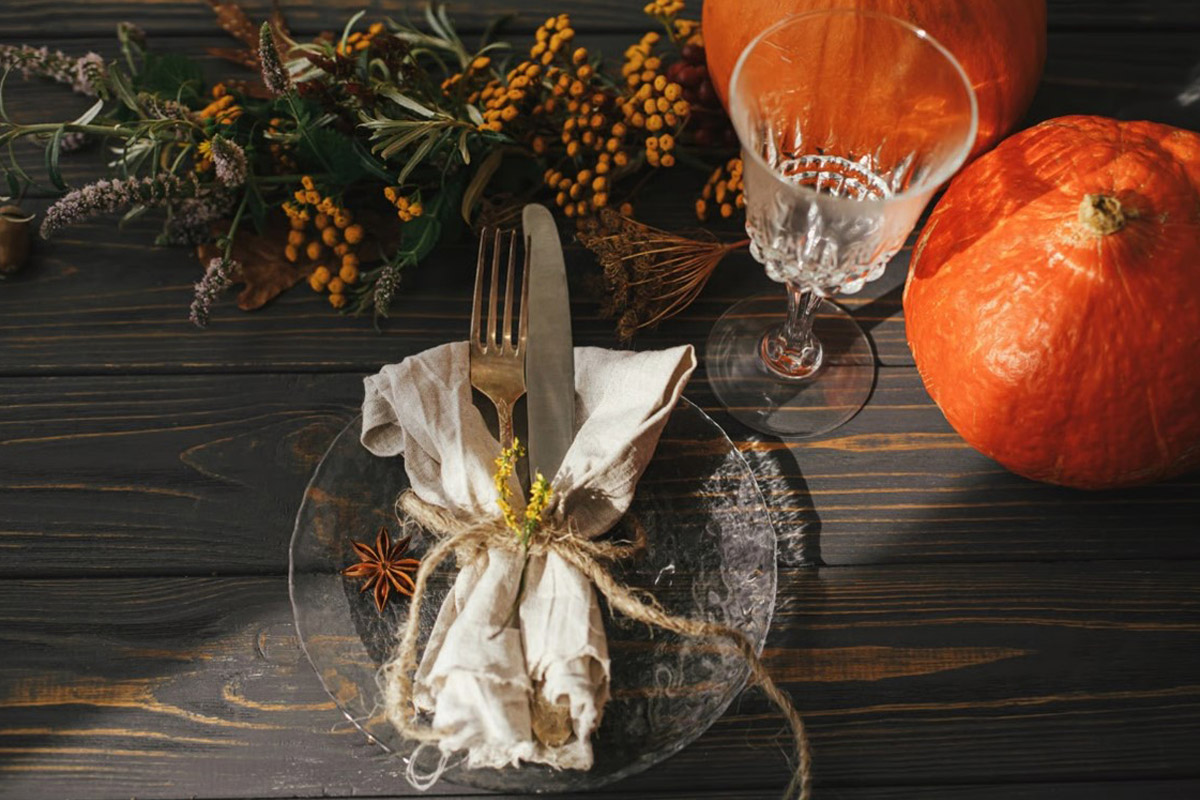
The format remains much the same: gathering at home (it should never really be done at a restaurant), cooking together, and sharing seasonal food in abundance. You don’t need a turkey — autumn dishes will do: pumpkin, chestnuts, mushrooms, roasted vegetables, slow-cooked meats.
Some call it Friendsgiving (a term I love!) — an informal version where everyone brings a dish. Others stick to a more traditional setup. The common denominator is the chance to say things we often leave unsaid: “Thank you for being there.” “I’m grateful for this.” Around a full table, those words carry new weight.
It’s an odd holiday for non-Americans — a ritual that doesn’t belong to our historical roots — yet it works surprisingly well because it arrives free of heavy traditions or social expectations. There are no gifts to buy, no religious liturgies, no strict codes of conduct.
It’s simply the desire to gather, eat, and give thanks — an imported ritual that becomes a beautiful excuse to do something we should probably all do more often.
At Raremood, for instance, we already have much to be thankful for: to our readers and friends for the many messages you’ve been sending us, eager to see the platform go live (it’s almost ready — we’re in the final testing phase!); to all the wonderful artists, artisans, and entrepreneurs who have placed their trust in this project; and — allow me to say it — to my team, who have been working beautifully, in harmony and with genuine joy. It deserves to be said!
In the meantime, Merry Christmas to all — and see you in the new year, for a 2026 together again.