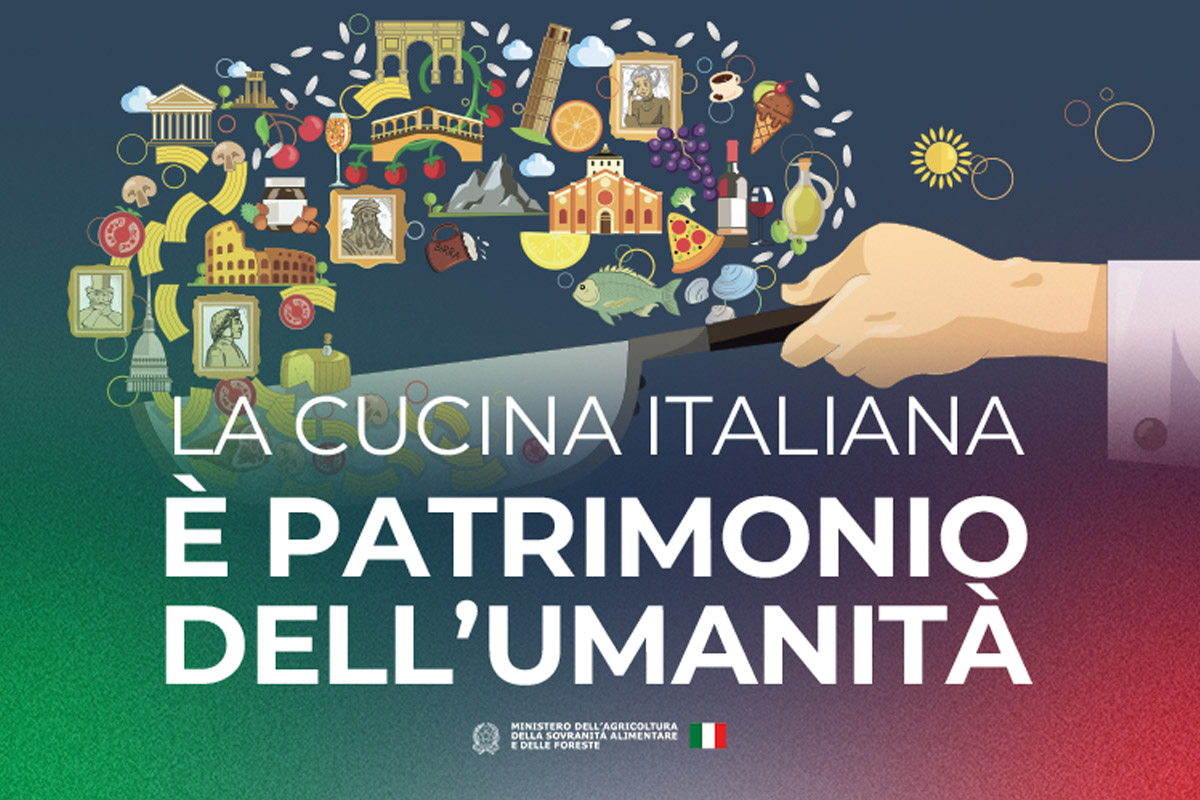
On December 10, 2025, in New Delhi, the UNESCO Committee made history: Italian Cuisine entered the List of the Intangible Cultural Heritage of Humanity, the first cuisine in the world recognized as a complete system. For Italy, it’s a world record: nine agri-food recognitions out of twenty-one total.
UNESCO celebrated a living cultural ecosystem: everyday practices, domestic rituals, respect for seasonality, the intergenerational transmission of knowledge, waste reduction, and conviviality. In short, our ordinary way of living.
For Italians, eating has always meant caring for oneself and others, expressing love and reconnecting with one’s cultural roots.
Sustainability in Italian food is a form of DNA. Exactly what the FIPE Manifesto (Federazione Italiana Pubblici Esercizi) had already codified with its 5Rs: Refuse, Reduce, Reuse, Recycle, Recover.
Refuse the superfluous: no single-use, no impulsive purchases.
Reduce waste by planning meals and choosing bulk products.
Reuse everything : artichoke stems, radish leaves, banana peels. Nothing is thrown away; everything is transformed.
It’s the constant lesson of “poor” Italian cuisine, which was never poor at all, only intelligent.
UNESCO recognized precisely these anti-waste practices that we now call “sustainability,” but which for generations have been simply the Italian way of life.
The FIPE Decalogue
Ten FIPE principles translate a philosophy into action:
Food as storytelling.
Short supply chains ensuring fair prices for producers.
Respect for seasonality.
Zero waste.
Quality that gratifies both taste and well-being.
Doggy bags always offered by restaurateurs, even in Michelin-starred restaurants.
Energy and water savings.
Sustainable fishing.
Ethical meat production.
Integral use of the animal, stimulating creativity with lesser cuts.
A Domestic Revolution
This UNESCO recognition belongs to every family, every table, every recipe lovingly passed down.
The European Commission has found that 30 percent of food-related emissions depend on our daily choices.
Small gestures are enough: choosing seasonal, local, organic products; using beeswax wraps (reusable many times), natural cleaning kits, rags made from old fabrics, and always checking energy efficiency labels.
Sustainability as Pleasure
Lino Stoppani, President of FIPE, stated: “Food is not just merchandise, it is a condensation of social, cultural, and environmental values.”
Sustainability does not mean deprivation: it means rediscovering authentic flavors.
Italian tradition is rich with recipes born from reuse: panzanella, ribollita, polpette di pane raffermo. They were never “poor”: they were ingenious.
A special mention goes to Massimo Bottura’s “Why Waste?” project, in which top chefs create extraordinary dishes from food scraps.
Thirty percent of global greenhouse gas emissions come from the food sector.
UNESCO acknowledges that Italian cuisine, built on seasonality, territoriality, and creative reuse, already contains all the answers.
After all, it is worth €251 billion, representing 19% of the global restaurant market.
Italy’s food and wine tourism generates €40.1 billion, and this recognition could bring 18 million additional tourists to the country.
Beyond numbers, the meaning is profound: Italian cuisine becomes a living cultural practice, capable of fostering creativity, and dialogue across generations and cultures.
From Kitchen to Home
As bio-architects, we see a perfect parallel: a sustainable kitchen and a sustainable home both require awareness, planning, respect for resources, creativity, reuse, and lasting quality.
A home designed with local materials, mindful orientation, and zero waste mirrors a kitchen that favors local products, seasonal ingredients, and creative reuse.
With this recognition, Italy stands as a model of harmony between well-being and environmental respect, a culture where food is nourishment for both body and planet.