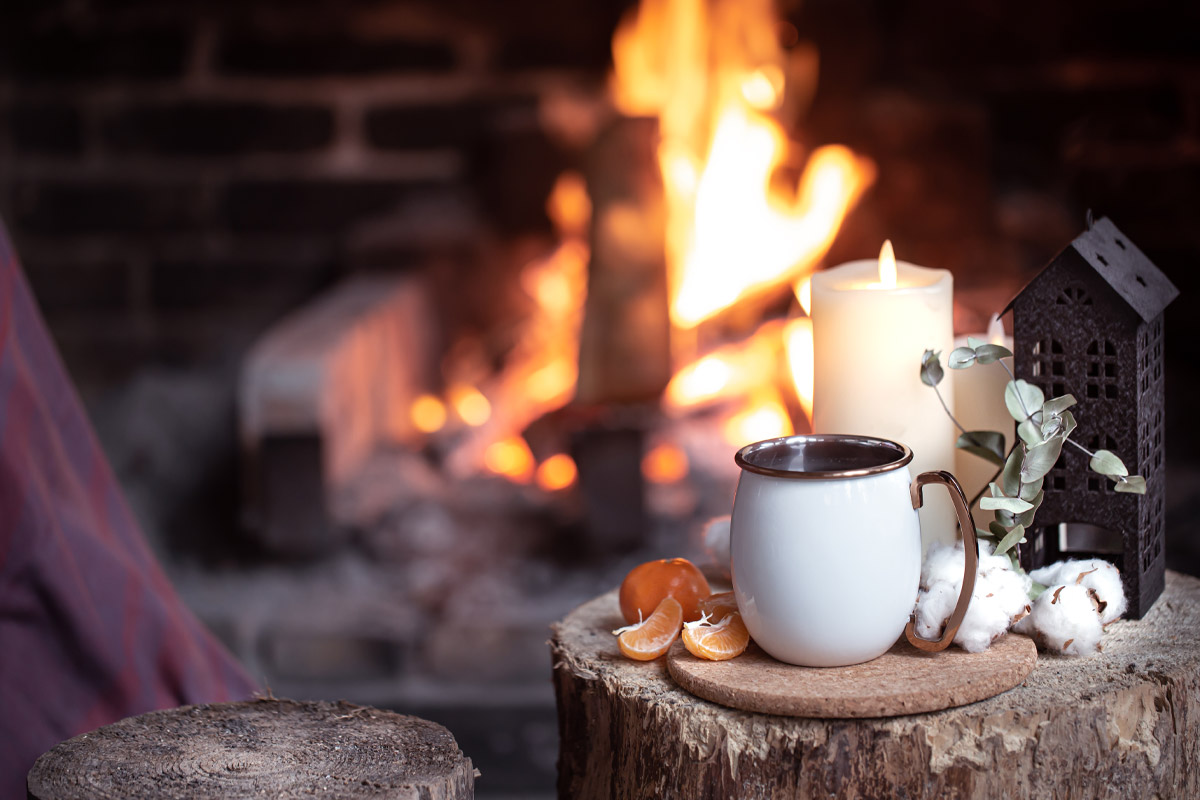
Bachelard wrote in The Flame of a Candle that fire is the only natural element capable of embodying two opposing values so clearly: good and evil. It warms and burns, illuminates and consumes, protects and destroys. Perhaps this is why, when winter arrives and the house closes itself to the cold, we instinctively seek out the fireplace, the candle, the dancing flame.
It’s not just a question of temperature.
A radiator heats better, but a LED light shines brighter. And yet, we light the fireplace even when it’s unnecessary, we place candles on every available surface, and we watch, mesmerized, that unpredictable movement no technology can replicate. Because fire warms something that radiant heat cannot reach: our “soul”, to use an ancient word that feels perfectly appropriate here.
The contemplative dimension of the flame
In To the Lighthouse, Virginia Woolf turns the flame of a candle into the emotional center of an entire domestic scene.
The characters gather around that flickering light, which defines a space of intimacy amid the surrounding darkness.
Fire creates boundaries: on this side, there is warmth and safety. Beyond lies the cold, the darkness, the threatening unknown. One of humanity’s oldest spatial divisions.
Watching fire is a form of involuntary meditation.
The flame never repeats itself, it constantly shifts in form, color, and intensity.
It forces the gaze to follow without prediction, demanding presence. You cannot watch fire and simultaneously think about your to-do list.
It relaxes because it demands total attention while asking for nothing in return.
The domestic ritual of the flame
Lighting a fireplace is a ritual: one that requires time, skill, and precise gestures. Choosing the right wood, arranging it with functional geometry, waiting for it to catch.
It’s not the instant gratification of a switch but a process that measures time differently. It compels you to slow down, to engage your hands, to build rather than merely activate.
Candles multiply this ritual on a smaller, domestic scale: selecting them, placing them, lighting them one by one as darkness advances beyond the windows.
In Fahrenheit 451, Ray Bradbury made fire a symbol of cultural destruction, but in daily life, domestic fire is exactly the opposite: the construction of habitable space, the creation of an atmosphere that allows reading, conversation, and thought.
Winter as the season of flame
There’s a particular quality to candlelight on a home wall in December, one that belongs to no other season.
Perhaps because the contrast with the darkness outside is starker, or because winter confines us indoors, turning that warm light into a boundary between the domestic refuge and the frozen world beyond.
Fire as presence
Perhaps this is the essence: fire is presence.
Not a neutral backdrop but a living entity sharing space with us, one that needs nourishment (wood, wax), one that is born, grows, and dies according to its own rhythm.
It has personality: every fireplace burns differently; beeswax candles have a distinct flame from those made of soy.
When we light a fire at home in winter, we are not merely heating rooms.
We are bringing a living element back into the domestic sphere, transforming dwelling from function into experience.
And perhaps that’s why, as temperatures drop and days shorten, our longing for flame becomes urgent: not for the heat it gives, but for the companionship it offers.